Oregon Rent Control Since 2019: What Changed Every Year
TL;DR
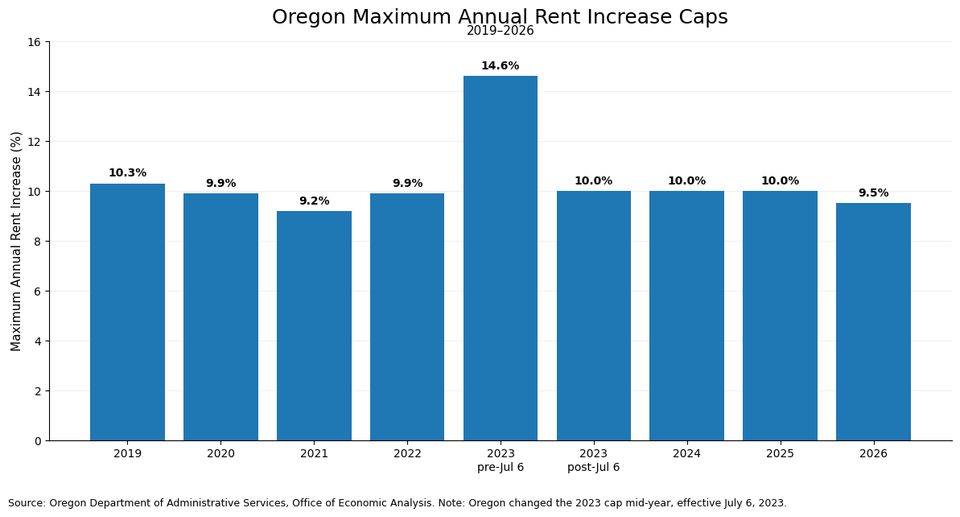
How has Oregon's rent control law changed since 2019? Oregon now ties rent increase caps to inflation rather than fixed percentages, with 2026 at 9.5% and 2027 at 10%.
- Check the state's published cap every October before writing renewal notices.
- No-cause termination rules, notice periods, and relocation assistance have also shifted since 2019.
Oregon’s rent increase limit is one of those numbers landlords tend to remember from the last time they used it, and that can be a problem.
The cap is not fixed. It changes from year to year because Oregon’s rent control law is tied to inflation. So if you are preparing a new lease, renewal, or rent increase notice and using the same percentage you used last year, you may already be working with outdated information.
The safest approach is simple: check the current annual limit every single time before you send a notice.
I want to walk you through where this all started, why the number bounces around instead of staying flat, and where things stand right now, because landlords who do not stay on top of this are the ones who end up in the kind of trouble that is entirely avoidable.
Senate Bill 608 started the clock in 2019
Oregon became the first state in the country to pass a statewide rent control law when Senate Bill 608 was signed in 2019. Before that, landlords in Salem, Keizer, and everywhere else in the state could raise rent by any amount, with notice, and that was that. SB 608 changed the baseline by tying the maximum allowable rent increase to a formula instead of leaving it unregulated, and it also put new limits on no-cause terminations for tenants who had been in a unit for a year or more. New construction was built with an exemption window that applies to properties less than 15 years old, so developers and smaller builders adding housing stock were not immediately subject to the same cap, which matters if you own anything recently built in Salem or Keizer and are not sure which rules apply to you.
The part that trips people up is that SB 608 did not set a flat percentage. It set up a method for calculating the cap, and that method is pegged to inflation & more notably the Consumer Price Index (CPI), so as the cost of living moves, the allowable increase moves with it. That was the whole design. Lawmakers wanted a number that would flex with the economy instead of a fixed figure that would get outdated the first year prices moved.
Why the number has not stayed the same since 2019
Here is the part I actually spend the most time explaining to landlords. Because the cap is tied to the CPI, the years right after the law passed and the years during the run up in consumer prices nationally did not produce the same allowable increase. A formula that reacts to inflation is going to spit out a low number when inflation is low and a higher number when inflation runs hot, and Oregon has seen both of those conditions since 2019. On top of that, the legislature has gone back and adjusted pieces of the formula more than once since the original bill passed, which is exactly why I tell people not to trust their memory of what the cap was two or three years ago. The mechanism itself has been tweaked, not just the output.
Pay close attention, the new Rent Caps come out at the end of September each & every year. Even over exaggerating the maximum rent by 0.1% can cost you big as a self-managing landlord.
Where the cap stands now

For 2026, the maximum allowable rent increase for a multifamily tenant in Oregon is 9.5 percent. For 2027, the state already published the new figure in October 2026, and it moved to 10 percent. I wrote up the 2027 number in more detail, including why hitting that ceiling is not automatically the right move for every owner, in Oregon's current rent increase cap and strategy considerations. That post is worth reading before your next renewal notice goes out, because the legal maximum and the smart business decision are not always the same thing, especially if you are trying to keep a good tenant in place.
The practical habit I want every landlord reading this to adopt is simple: check the current year's number before you write a single renewal notice, every single year, rather than assuming it is the same as last year or close enough to not matter. The state publishes the following year's figure in October, which is also why I update my own numbers around this time every fall. If you manage even one rental, put a reminder on your calendar for early October and treat it the same way you treat renewing your landlord insurance.
The cap is not the only rule that has shifted
Rent increases get all the attention, but the cap is only one piece of a landlord-tenant framework that has moved quite a bit since 2019. No-cause termination rules, notice periods, and in certain situations relocation assistance obligations have all been part of the broader shift, and they interact with each other more than people expect. If you are ending a tenancy around the same time you are raising rent, or if you are converting a unit to owner use, it is worth understanding relocation assistance obligations under Oregon law before you send anything in writing, because getting the sequence wrong can turn a routine transition into a dispute. The same goes for the eviction side of things. The process for Oregon eviction procedures and tenant termination rules has specific notice requirements that have changed enough over the past several years that an owner relying on what they remember from a decade ago is operating on outdated information.
This is the piece I keep coming back to with landlords who want to handle everything themselves. A property is usually one of the biggest assets a person owns, and the rules governing how you manage tenants in that property have changed enough in the past six or seven years that an amateur can genuinely get hurt by not knowing them, or by knowing an old version of them. I am not saying you need a property manager for every duplex. I am saying the compliance side of this job deserves the same respect you would give a dentist or a mechanic. You would not try to diagnose a transmission problem yourself to save money. The stakes on a rental property are higher than the stakes on a transmission.
What this means for your next renewal notice
If you are sitting down to calculate a rent increase right now, the process is the same every year even though the number changes. Confirm the current year's maximum allowable percentage from the state's published guidance, apply it to the tenant's existing rent, and make sure your notice period and written notice meet the current statutory requirements, since those have also been adjusted over the years. I would also encourage you to think past the legal ceiling and ask whether pushing to the max makes sense for that specific unit and that specific tenant, which is the exact argument I laid out in the 2027 cap post linked above. A long-term tenant who pays on time and takes care of the property is worth more to your cash flow over several years than squeezing out the last percentage point of a legal increase and risking turnover.
None of this replaces a conversation with a landlord-tenant attorney if you have a lease-specific question or a tenant situation that feels unusual. I can tell you what the current numbers are and how the rules generally apply, but I am not going to pretend to give you legal advice on your specific lease, and neither should any real estate agent. That is a different professional, for a different part of the job, and a good one is worth the conversation before you act.
Questions people ask
What are the benefits of buying multifamily and investment property?
I open almost every first conversation with a new investor by walking through the same handful of reasons people end up buying multifamily in the first place, and I don't rank them because the order depends on who's sitting across from me. There's the rent check that actually covers the mortgage and then some every month, there's the chance the building itself is worth more down the road than what you paid for it, there's the fact that your tenant is quietly paying off your loan balance for you year after year, there's what a tax preparer can do for you with depreciation and write-offs that a regular paycheck never gets, and there's just having money parked somewhere other than the stock market in case that market has a bad decade. Different buyers latch onto different ones of those, and that's fine with me. I just want someone walking in the door to know all of them exist instead of locking in on the monthly rent number and ignoring everything else.
Do you charge late fees to your tenants?
Oregon law allows late fees, but there are specific rules about how and when they can be charged, so this is not a fill-in-the-blank line on a generic lease template. I covered the details on both late fees and security deposits, including what is and is not allowed, in Oregon security deposit rules and late fee requirements, and I would read that before you set a policy rather than copying whatever a friend's lease says.
How do you go about finding the market rent for certain properties?
I pull current active and comparable rental listings in the same submarkets and then cross reference that info with my list of reputable Property Managers in the area to obtain the most up to date rental information. Whether that is a fourplex in Keizer or a small apartment building in Salem, and I compare unit size, condition, and amenities directly rather than relying on a citywide average that does not reflect your specific building. Rent increase caps tell you the maximum you are allowed to raise an existing tenant's rent, but they do not tell you what a vacant unit should actually rent for on the open market, and those are two completely different numbers that get confused constantly.
If you own rental property in Salem or Keizer and want someone to pull current comps, walk through this year's numbers, or just sanity check a renewal notice before it goes out, reach out and I am happy to look at it with you. Give me a call!

Jordan Sparks
Principal Broker, Sparks Property Group at SMI Real Estate. Specializing in Multifamily and Investment property in Salem, Keizer, and the Willamette Valley. Licensed in Oregon, #200610098.
jordan@smire.com · 541.646.0650
Connect with Sparks Property Group ↗






Member discussion